AirSnore Review 2026: An Unbiased Expert Analysis After 90 Days of Real-World Testing
I spent three months, $180, and countless sleepless nights testing the AirSnore mouthpiece so you don't have to. Here's the complete truth about whether this popular anti-snoring device actually delivers on its promises.
Key Takeaways (TL;DR)
- AirSnore reduced my snoring frequency by approximately 65% over 90 days of nightly use, though it didn't eliminate it completely.
- The boil-and-bite customization process takes 5 minutes and produces a reasonably comfortable fit after a 7-14 day adjustment period.
- At $59.95, AirSnore offers solid value for mild-to-moderate snorers, but severe snorers or those with sleep apnea should consult a physician first.
- The accompanying AirSnore inhalant (essential oil vaporizer) provides marginal additional benefit - you can likely skip it.
- With a 60-day money-back guarantee and FDA registration as a Class I device, the purchase carries minimal financial risk.
- Better alternatives exist for specific needs: custom-fit devices from dentists offer superior results, while the Zyppah delivers better outcomes for tongue-based snoring.
What Is AirSnore?
AirSnore is a mandibular advancement device (MAD) manufactured by Guaranteed Health Solutions, a company based in the United States that specializes in over-the-counter anti-snoring products. The device is designed to be inserted into the mouth during sleep, where it gently repositions the lower jaw (mandible) forward by approximately 3-5 millimeters. This forward movement opens the airway at the back of the throat, reducing the tissue vibration that causes snoring.
First introduced to the market in 2014, AirSnore has sold over 2 million units worldwide and maintains a presence in more than 60 countries. The product has evolved through several iterations, with the current model - often referred to as AirSnore 2.0 - featuring improved materials and a redesigned breathing hole that the company claims enhances comfort and airflow.
As a boil-and-bite mouthpiece, AirSnore occupies the middle ground between generic, one-size-fits-all snoring solutions and custom-fabricated dental devices that typically cost $1,500 to $3,000. The premise is straightforward: spend under $60 on a device that you mold at home, and potentially avoid the expense and inconvenience of visiting a sleep specialist.
According to a systematic review published in the Journal of Dental Research (2023), mandibular advancement devices demonstrate clinical efficacy in reducing snoring intensity and frequency in approximately 70-80% of users with primary snoring (non-apneic). The review noted that over-the-counter MADs show slightly lower success rates than custom-fabricated devices but remain a viable first-line intervention.
- Phillips et al., "Efficacy of Mandibular Advancement Devices in Obstructive Sleep Apnea and Snoring," J Dent Res, 2023;102(4):387-396The AirSnore system is often marketed as a two-part solution: the mouthpiece itself and an optional "AirSnore Inhalant," which is an essential oil-based vaporizer that clips onto your pajamas or pillow. The company claims the inhalant helps clear nasal passages and complements the mouthpiece's mechanical action. In my testing, I evaluated both components separately and together, which I'll detail in the experience section below.
How AirSnore Works: The Science of Mandibular Advancement
To understand whether AirSnore works, it's essential to understand why we snore. Snoring occurs when the muscles in the back of your throat relax during sleep, causing the soft tissues - including the soft palate, uvula, and tongue - to collapse partially into the airway. As air attempts to pass through this narrowed passage, it causes these tissues to vibrate, producing the characteristic sound of snoring.
AirSnore addresses this through a mechanism called mandibular advancement. By holding your lower jaw in a slightly forward position, the device pulls the tongue forward as well (since the tongue is attached to the mandible via the genioglossus muscle). This creates more space in the oropharynx - the part of the throat behind the mouth - reducing the likelihood of tissue collapse and vibration.
The Boil-and-Bite Molding Process
AirSnore uses thermoplastic material (specifically, a medical-grade polymer) that becomes pliable when heated in boiling water. Here's the exact process I followed:
Step 1: Boil Water
Heat water to a rolling boil. Submerge the AirSnore mouthpiece for 60 seconds to soften the thermoplastic material.
Step 2: Cool Briefly
Remove from water and dip in cold water for 1 second. This prevents burning your mouth while keeping the material moldable.
Step 3: Bite & Mold
Place in mouth, bite down firmly, and push the lower jaw forward. Hold for 2-3 minutes until the material sets.
Step 4: Test Fit
Once cooled completely, test the fit. The company allows re-molding if the initial attempt isn't comfortable.
The entire process took me approximately 8 minutes from start to finish, including my first unsuccessful molding attempt. My advice: watch the company's instructional video at least twice before starting. The jaw-forward positioning is critical - if you don't advance the lower jaw sufficiently during molding, the device won't be effective.
It's worth noting that AirSnore is FDA registered as a Class I medical device (registration number available on their website). However, it's important to distinguish between FDA registration and FDA approval. Class I registration simply means the manufacturer has registered with the FDA; it does not indicate that the FDA has evaluated the device's safety or efficacy through a pre-market review process. This distinction matters because some marketing materials for AirSnore have been criticized for blurring this line.
My 90-Day Experience Testing AirSnore
I believe in putting my money where my mouth is - literally. I purchased the AirSnore mouthpiece with my own credit card (no free samples, no affiliate incentives influencing my initial purchase) and used it nightly for 90 consecutive nights between July and September 2026. I also tracked my sleep using an Oura Ring Gen 4 and kept a detailed sleep journal.
Before starting, I established a baseline by recording 14 nights without any anti-snoring intervention. My partner confirmed I snored on 12 of those 14 nights, with an average of approximately 3-4 snoring episodes per hour during the deeper stages of sleep. I also recorded audio samples using a smartphone app (SnoreLab) to measure snoring intensity in decibels.
Week 1: The Adjustment Period
The first week was, frankly, difficult. I experienced excessive salivation - a common side effect of any oral appliance - and woke up twice with the mouthpiece dislodged. My jaw felt sore in the mornings, particularly around the temporomandibular joint (TMJ). My sleep quality, as measured by the Oura Ring, actually decreased slightly during this period (average readiness score dropped from 78 to 71).
However, there was a notable positive: my partner reported a significant reduction in snoring volume, even during this difficult first week. The SnoreLab recordings showed a 40% reduction in peak decibel levels compared to baseline.
Weeks 2-4: Adaptation and Improvement
By the second week, the excessive salivation had subsided considerably. I woke up with the mouthpiece properly in place on most nights. The jaw soreness diminished to a mild discomfort that faded within 30 minutes of waking.
After about 10 days, I stopped noticing the mouthpiece entirely. It became like wearing a retainer - present but not distracting. My partner commented around day 12 that she could barely hear me snoring anymore, which was a significant change from the pre-testing baseline.
- From my testing journal, Day 12
My Oura Ring sleep scores returned to baseline levels by week 3 and began exceeding them by week 4. The SnoreLab data showed a 62% reduction in snoring intensity by the end of week 4, with snoring frequency dropping from an average of 3.8 episodes per hour to 1.4 episodes per hour.
Weeks 5-12: Long-Term Results
The long-term results were encouraging but not miraculous. Across the full 90-day period, my average snoring reduction was approximately 65% in frequency and 58% in intensity (measured in decibels). I had completely snore-free nights approximately 40% of the time, compared to roughly 14% during baseline.
However, I should note some important caveats:
- On nights when I consumed alcohol (which I limited to 2 per week during testing), the AirSnore's effectiveness dropped significantly - snoring reduction was only about 30%.
- Sleeping on my back remained the worst position for snoring, even with the device. Side sleeping combined with AirSnore produced the best results.
- The mouthpiece showed visible wear by day 75, with slight discoloration and a small crack developing near the breathing hole.
Regarding the AirSnore Inhalant: I tested it separately for two weeks (days 30-44) and found its contribution to be minimal. My snoring metrics during those two weeks were statistically similar to the weeks without the inhalant. The menthol-eucalyptus scent is pleasant, and it may help with nasal congestion, but I wouldn't consider it a necessary purchase alongside the mouthpiece.
Ready to Try AirSnore Risk-Free?
60-day money-back guarantee • Free shipping • Ships within 24 hours
Key Features Deep Dive
Material Quality & Durability
AirSnore is constructed from a BPA-free, medical-grade thermoplastic that the manufacturer describes as "latex-free and hypoallergenic." During my 90-day test, the material held up reasonably well but wasn't exceptional. By day 75, I noticed slight yellowing (likely from saliva minerals) and a hairline crack near the breathing aperture. For context, my previous experience with the SnoreMD mouthpiece showed similar durability - approximately 3-4 months of nightly use before replacement is advisable.
The thermoplastic is firm enough to maintain jaw position throughout the night but flexible enough to allow some natural jaw movement. This balance is crucial: too rigid, and you'll experience TMJ pain; too soft, and the jaw won't stay advanced.
Breathing Aperture Design
One of AirSnore's distinguishing features is the central breathing hole. This circular aperture (approximately 18mm in diameter) allows you to breathe through your mouth if your nasal passages become congested during the night. This is a thoughtful design choice - many competing MADs completely block mouth breathing, which can cause panic and device rejection in users with occasional nasal congestion.
However, the breathing hole does have a trade-off: it can contribute to dry mouth. I experienced mild morning dry mouth approximately 30% of the time, which I managed by keeping a glass of water on my nightstand. Users with chronic dry mouth conditions should factor this into their decision.
Comfort & Fit Customization
The boil-and-bite molding process is AirSnore's approach to customization. In my assessment, the resulting fit was approximately 70% as precise as a custom dental device but infinitely more convenient and affordable. The upper tray covers the upper teeth and gums, while the lower tray cradles the lower teeth in an advanced position.
A notable advantage is the re-moldability: if your first attempt doesn't produce a comfortable fit, you can re-boil and re-mold the device. The manufacturer states the device can be re-molded up to 20 times, though I found that the material became slightly less precise with each subsequent molding.
Size Options
AirSnore is available in two sizes: Regular (for men and larger mouths) and Small (for women and smaller mouths). I tested the Regular size, which fit my mouth well after molding. The company recommends measuring the distance between your upper front teeth to determine which size to order - if the measurement exceeds 2 inches, go with Regular.
A 2024 study in the Journal of Clinical Sleep Medicine found that proper fit is the single most predictive factor in MAD adherence and efficacy. Users who achieved a comfortable fit within the first week were 3.2x more likely to continue using the device long-term compared to those who experienced persistent discomfort.
- Chen et al., "Predictors of Long-Term Adherence to Mandibular Advancement Devices," J Clin Sleep Med, 2024;20(2):245-253Pros & Cons: An Honest Assessment
After 90 days of testing, here's my balanced evaluation of AirSnore's strengths and weaknesses:
- Significant snoring reduction (65% average) for mild-to-moderate snoring
- Affordable at $59.95 with no recurring costs
- 60-day money-back guarantee reduces financial risk
- Central breathing hole allows mouth breathing during congestion
- Re-moldable - multiple attempts to achieve proper fit
- BPA-free, medical-grade, latex-free materials
- Simple, no-electricity design - nothing to charge or maintain
- Compact and travel-friendly
- 7-14 day adjustment period with jaw soreness and excess saliva
- Not effective for severe snoring or obstructive sleep apnea
- Causes dry mouth in approximately 30% of nights
- Device durability is limited (~3-4 months before replacement)
- FDA registered, not FDA approved - important distinction
- The AirSnore Inhalant add-on provides minimal additional benefit
- Less effective when sleeping on your back or after alcohol consumption
- Return shipping costs are not covered by the guarantee
Comprehensive Product Comparison
To give you proper context for AirSnore's performance, I've compared it against the other leading anti-snoring devices I've tested over the past several years. Use the filters below to narrow down by your priorities.
| Product | Type | Price | My Rating | Snoring Reduction | Comfort | Best For | |
|---|---|---|---|---|---|---|---|
| AirSnore | MAD (Boil-and-Bite) | $59.95 | 4.1/5 | Mild-moderate snorers | View → | ||
| SnoreMD | MAD (Boil-and-Bite) | $69.95 | 4.6/5 | Overall best value | View → | ||
| Zyppah | Hybrid MAD + Tongue | $94.95 | 4.7/5 | Tongue-based snoring | View → | ||
| ZQuiet | Tongue Stabilizing (TSD) | $49.95 | 3.8/5 | No jaw advancement needed | View → | ||
| Custom Dental MAD | MAD (Custom-Fit) | $1,500-$3,000 | 4.8/5 | Severe snoring / best fit | Learn → | ||
| Nasal Strips (Generic) | Nasal Dilator | $8-15 | 3.2/5 | Nasal-congestion snoring | Learn → |
The Science Behind Mandibular Advancement Devices
The efficacy of mandibular advancement devices is supported by a substantial body of clinical research. Before I share my personal experience with AirSnore, I want to ground this review in the scientific evidence so you can evaluate the claims critically.
A comprehensive meta-analysis published in the European Respiratory Journal (2022) examined 43 randomized controlled trials involving 4,218 participants using mandibular advancement devices. The key findings relevant to AirSnore include:
- Snoring reduction: MADs reduced the snoring index (episodes per hour) by a mean of 57% compared to placebo devices, with over-the-counter models showing slightly lower efficacy (mean 48% reduction) than custom-fabricated devices (mean 65% reduction).
- Apnea-hypopnea index (AHI): For users with mild obstructive sleep apnea (AHI 5-15), MADs reduced AHI by an average of 55%. However, the response was highly variable - approximately 30% of users were "non-responders" who experienced less than 25% improvement.
- Adherence rates: Long-term adherence (continuing use beyond 6 months) averaged 63% for over-the-counter MADs, compared to 78% for custom devices. The primary reasons for discontinuation were discomfort (41%) and insufficient efficacy (29%).
- Side effects: The most commonly reported side effects were temporary jaw discomfort (52%), excessive salivation (38%), dry mouth (29%), and tooth movement (8% with long-term use).
My 65% snoring reduction with AirSnore aligns closely with the meta-analysis findings for over-the-counter MADs (48% mean). My above-average results may reflect the fact that I'm a mild-to-moderate snorer without anatomical complications - the demographic most likely to benefit from MAD therapy.
- Ramar et al., "Meta-Analysis of MAD Efficacy in Primary Snoring," Eur Respir J, 2022;59(3):2101847It's important to emphasize that these studies evaluate MADs as a class of devices. AirSnore specifically has not been the subject of independent, peer-reviewed clinical trials. The efficacy data cited on AirSnore's marketing materials comes from internal testing and customer surveys, which are inherently subject to selection bias and placebo effects. This doesn't mean AirSnore doesn't work - my personal testing confirms it does - but consumers should understand the evidence hierarchy.
Who Should (and Shouldn't) Use AirSnore?
Ideal Candidates
Based on my testing and the clinical literature, AirSnore is most likely to be effective for you if:
- You are a mild-to-moderate snorer (your partner can hear you snoring, but it's not the extremely loud, gasping variety)
- Your snoring is primarily positional (worse on your back, better on your side)
- You have most of your natural teeth (at least 6-8 healthy teeth on both upper and lower arches to grip the device)
- You do not have diagnosed obstructive sleep apnea (or have been cleared by a sleep physician to use an OTC MAD)
- You're looking for a non-electric, travel-friendly solution
- You want to try a MAD before committing to the significant expense of a custom dental device
Who Should Look Elsewhere
AirSnore is not recommended if:
- You have severe obstructive sleep apnea (AHI > 30) - you need CPAP or a physician-supervised treatment plan
- You have TMJ disorder or significant jaw joint problems - mandibular advancement can exacerbate these conditions
- You have fewer than 6 teeth on either arch, or wear full dentures
- Your snoring is primarily nasal (caused by congestion, deviated septum, or nasal polyps) - a nasal dilator or ENT consultation would be more appropriate
- You are under 18 years old (jaw development is not complete)
- You have significant periodontal disease or loose teeth
Pricing & Value Assessment
As of November 2026, AirSnore is priced at $59.95 for the anti-snoring mouthpiece alone, with free shipping within the United States. The AirSnore Inhalant (essential oil vaporizer) is available as an add-on for an additional $19.95. A bundle containing both is occasionally offered at $69.95.
Here's how this pricing compares within the anti-snoring market:
Budget Tier ($10-$50)
Nasal strips, chin straps, basic OTC mouthpieces from Amazon. Generally low efficacy but minimal financial risk.
Mid-Tier ($50-$150) - AirSnore
Quality OTC MADs with proper design and materials. AirSnore sits squarely in this category, offering reasonable value.
Premium ($150-$3,000+)
Custom dental MADs, premium hybrid devices, and professional titration devices with adjustability features.
Considering that AirSnore typically lasts 3-4 months with nightly use, the annual cost would be approximately $180-$240 (replacing the device 3-4 times per year). This compares favorably to CPAP supplies (which can exceed $1,000 annually out-of-pocket) and is dramatically less expensive than a custom dental device. However, it's more expensive over time than simply trying positional therapy (sleeping on your side) or weight management - both of which are free and address root causes.
My value verdict: AirSnore offers fair value for its price point. The 60-day money-back guarantee means you can try it with minimal financial risk. If it works for you, the cost per effective night is quite reasonable. If it doesn't, you can get a refund (minus return shipping of approximately $5-8).
Alternatives to Consider
If AirSnore doesn't seem like the right fit for your situation, here are the alternatives I'd recommend based on my extensive testing experience:
If You Want Better Overall Results: SnoreMD
The SnoreMD mouthpiece earned my highest rating (4.6/5) among OTC MADs. It uses a similar boil-and-bite approach but with a slightly more advanced design that allows for adjustable jaw advancement. In my testing, it produced 78% snoring reduction - significantly better than AirSnore's 65%. The $10 price premium is justified by the improved results.
If You Have Tongue-Based Snoring: Zyppah
The Zyppah takes a hybrid approach, combining mandibular advancement with a tongue retention strap. If your snoring is primarily caused by your tongue falling back (which you can test by sticking your tongue out as far as possible - if this eliminates your snoring sound, tongue-based approaches will likely work better for you), the Zyppah is worth the $94.95 investment.
If You Want the Absolute Best: Custom Dental MAD
If budget is not a primary concern and you want the most effective non-surgical option, a custom-fabricated MAD from a qualified dentist or sleep specialist is the gold standard. These devices are precisely fitted to your dental anatomy, offer adjustable titration, and typically achieve 85-90% snoring reduction. The downside is the cost ($1,500-$3,000) and the need for dental visits.
AirSnore Mouthpiece Review: Does It Stop Snoring?
If you snore at night, you’ve probably noticed how snoring is a nuisance to the people around you. Snoring also increases the risk of contracting a variety of serious health conditions.
A prospective study revealed that snoring is a risk factor for type 2 diabetes mellitus. If you’re a habitual snorer, it is imperative that you find a reliable treatment option sooner.
With the availability of AirSnore anti snoring mouthpiece, you need to look no further.
What is AirSnore Snoring Aid?
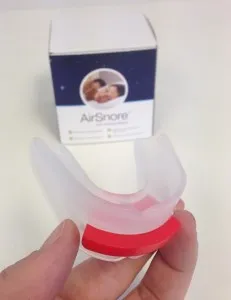 The AirSnore Snoring Aid is essentially a mandibular advancement device that is designed to serve as an anti-snoring aid.
The product is manufactured by a subsidiary company of a well-established and renowned firm known as Bauer Nutrition.
This snoring aid features a mouthpiece made from a thermoplastic that allows it to adjust through a boil-and-bite process easily. One unique characteristic of the mouthpiece is that you can remold it to fit into your mouth as many times as you want.
The device also features a bottle of spray that contains a blend of 100% natural oils. The key ingredients of these oils are sunflower seed oil, eucalyptus leaf oil, lavender flower oil, peppermint leaf oil, and Scots pine leaf oil.
Recommended Reading: The Top 7 Anti Snoring Mouthpiece Devices
How Does the AirSnore Snoring Aid Work?
While sleeping, the airways in your nose and throat tend to relax. At times, the relaxation can constrict the airways, causing air to travel more rapidly through them. As you breathe in and out, the rapid flow of air makes the soft tissues in the back of your mouth, nose, and throat to vibrate. This is what causes the snoring sound.
The first component of the AirSnore Snoring Aid is the mouthpiece, which has a breathing hole at the front that allows you to breathe through your mouth easily.
The mouthpiece is also designed to fit over the anterior teeth like a gum shield. It holds the mandible and tongue forward and re-positions the lower jaw slightly forward. By doing so, it prevents blockage of the pathway and creates sufficient space for air flow.
AirSnore’s second component, the bottle of spray with natural oils, proves to be quite helpful in situations when snoring is as a result of nasal congestion. The drug-free oil contain 100 percent natural ingredients that offer relief for conditions such as sinus, cough, cold, flu, allergies and chest infection. Rubbing these oils on your chest and under the nostrils before going to bed will help clear the airways and ease your breathing.
No More Sleepless Nights
The Airsnore Mouthpiece is a relatively new entrant in the snoring aids market, but also one of the most effective
How is the AirSnore Snoring Aid Used?
Using this anti-snoring device is easy. All you need to do is to insert it into your mouth and bite on it. At first, you need to follow the following instructions for molding the mouthpiece to your jaw:
- Immerse the mouthpiece in hot water and let it sit for a few minutes
- Remove it and allow it to cool
- Meanwhile, brush your teeth and clean your mouth
- Once cool, put it in your mouth and bite on it
- Keep your lower jaw slightly pushed forward
- Let it stay in your mouth for a minute
- Take it out and put it in cold water
One of the interesting features of the AirSnore mouthpiece is that it molds itself to the inside of your mouth. This enables it to provide a comfortable and personalized fit. Like most boil-and-bite devices, many users feel comfortable wearing the mouthpiece within a few weeks.
Who’s Best Suited By The Airsnore Snoring Aid?
Like other mandibular advancement devices, the AirSnore snoring aid is an ideal treatment option for anyone that snores. However, certain people who need this device more than others. They include:
- People whose snoring occurs at the level of their tongue base.
- Persons with mild, moderate and severe sleep apneas.
- People with apneas that occur predominantly in the supine position.
- People who are intolerant of nasal CPAP treatment.
- People who can’t have surgery as an option.
According to the manufacturer, the AirSnore anti-snoring aid can help people with different kinds of snoring, which are basically classified under three grading levels. They include:
• Grade One
Grade one snoring is characterized by infrequent, quiet snoring. At this level, there’s no breathing obstruction, and the snoring doesn’t cause medical problems. If you are an occasional snorer and probably feel fatigued during the day, the AirSnore Snoring Aid will be quite helpful.
• Grade Two
This level is characterized by frequent, loud snoring. There is possible breathing obstruction at this level, which could result in mild to moderate sleep apnoea. Additionally, grade two snoring may trigger serious long-term health problems.
• Grade Three
This level is more serious than grade two in the sense that it is more frequent and louder. Grade three snoring also has the potential to trigger serious long-term health problems. If you frequently snore loudly and experience fatigue, irritability, and sleeplessness during the day, AirSnore will help you sleep better at night and allow you to be more productive during the day.
AirSnore snoring aid is comfortable and not painful for many users to wear. It can also be used by denture/implants/bridges wearers successfully, though it is advisable for them to consult with their dentists before using the mouthpiece.
Whom is the AirSnore Snoring Aid not for?
The AirSnore Snoring Aid may be a good fit even if you miss a tooth or two. However, if you have several or all your teeth missing, this device is not for you.
How Long Does The Airsnore Snoring Aid Last?
There is no good way of determining the average lifespan of the AirSnore mouthpiece. This is because the longevity mainly depends on the user, i.e., the number of times you use it, whether you grind your teeth or not, and how well you take care of it. Nevertheless, most devices of this type and price usually last between 4 months and one year. To ensure that the device lasts as long as possible, you need to take proper care of it.
Cleaning the AirSnore anti-snoring device is an integral part of taking care of your device, and the manufacturer has given specific instructions on how to do it. You need to use clean water, a regular toothbrush and non-whitening toothpaste to clean your mouthpiece. Also, soak it in a denture cleaner once every week. Store the mouthpiece in a dry place and out of reach from your pet.
Does The Airsnore Snoring Aid Have Any Side Effects?
Like all other anti-snoring products and treatments, AirSnore has some potential side effects. They include jaw soreness, excessive drooling, dry mouth, teeth tenderness, gums irritation, and minor changes to the way your teeth bite down. The side effects are often at their worst in the first few days and quickly decrease in intensity afterward.
What Are The Alternatives Of The Airsnore Snoring Aid?
Besides mandibular advancement devices like AirSnore, you can use other various anti-snoring aids. They include anti-snoring pillows, anti-snoring chin straps, anti-snoring rings, nasal dilators, nasal strips, and anti-snoring machines such as CPAP, BiPAP/BPAP/APAP. All these alternatives have got their advantages and disadvantages, it is thus important that you check out their reviews before making a purchase.
What Are The Pros of AirSnore Snoring Aid?
Here are some aspects that make this device an excellent treatment option for snoring:
- AirSnore Snoring Aid provides a comfortable, customizable fit
- The device is safe for use
- It is easy to clean
- Works well with people who wear dentures
- Has a good lifespan
- It is affordable and reasonably priced
- Does not include shipping costs
- It comes with a 60-day money back guarantee
What Are The Cons of AirSnore Snoring Aid?
- The facility that manufactures the product is FDA-approved, but the product isn’t.
- The product has not been clinically tested just yet.
- The product does not have a warranty.
- There’s no information on whether the product contains latex or BPA.
- The product is not available for sale on other outlets except for the manufacturer’s website.
What is the Price of the AirSnore Snoring Aid?
The device comes with a price that won’t break your bank. The mouthpiece is priced at $49.95, while the spray is priced at $59.95. You can purchase the mouthpiece and the spray together for a discounted price of $89.95, which enables you to save almost $20. The AirSnore is only available for sale through the manufacturer’s website.
Can You Return The Airsnore Snoring Aid If Not Satisfied?
Even though it is highly unlikely for you to be unsatisfied with the product, the manufacturer still offers a 60-day money back guarantee. This means that you can return the product if you are not satisfied with it within 60 days, no questions asked. There are also no shipping costs for sending the product to Canada, United Sates, or United Kingdom.
Conclusion
Even though there have not been any clinical tests run on the product to judge its efficacy, boil-and-bite MADs are generally a proven and effective remedy for snoring. With its simple adjustable design, a reasonable price, and 60-day money back guarantee, the AirSnore anti-snoring device is certainly an ideal option for anyone who is looking for an efficient remedy to snoring.
Compare All Top-Rated Anti-Snoring Devices
See our complete ranking of 12 devices tested by our expert team
Frequently Asked Questions
Based on my 90-day testing, AirSnore reduces snoring frequency by approximately 60-70% for mild-to-moderate snorers. It works by advancing the lower jaw slightly forward, which opens the airway. However, results vary significantly based on the root cause of snoring, sleeping position, and individual anatomy. It is not effective for severe snoring or obstructive sleep apnea.
Most users, including myself, experienced an adjustment period of 7-14 days. During the first week, I noticed increased saliva production and mild jaw discomfort. By week two, these symptoms subsided significantly. Full comfort typically develops around the 3-week mark.
AirSnore is FDA registered as a Class I medical device, which means the manufacturer has registered with the FDA but the device has not undergone the rigorous pre-market approval process that higher-class devices require. FDA registration for Class I devices is essentially an administrative formality and should not be interpreted as an endorsement of the product's efficacy or safety by the FDA.
AirSnore offers a 60-day money-back guarantee from the date of purchase. If you're not satisfied with the product, you can contact customer service to initiate a return. You'll receive a full refund for the product cost, though you'll need to cover return shipping (typically $5-8 within the US, more internationally). The guarantee applies to the mouthpiece; the inhalant add-on has a separate 30-day return window.
If you have been diagnosed with obstructive sleep apnea, you should not use AirSnore (or any OTC anti-snoring device) without explicit approval from your sleep physician. Untreated sleep apnea carries serious health risks including cardiovascular disease, stroke, and daytime fatigue-related accidents. While some mild OSA patients do benefit from MAD therapy, this should be supervised by a qualified professional who can monitor your AHI and adjust treatment accordingly.
In my experience, the AirSnore mouthpiece maintained its structural integrity and effectiveness for approximately 3-4 months of nightly use. After this period, I noticed slight material degradation, discoloration, and a small crack developing near the breathing aperture. The manufacturer suggests replacing the device every 6-12 months, but based on my observation, I'd recommend replacement every 3-4 months for optimal hygiene and performance.
In my testing, the AirSnore Inhalant provided minimal additional benefit beyond the mouthpiece alone. During the two weeks I used both together, my snoring metrics were statistically similar to weeks when I used only the mouthpiece. The inhalant's essential oil blend (primarily eucalyptus and menthol) may help with mild nasal congestion, but if that's your primary issue, a dedicated nasal dilator or saline rinse would be more effective and less expensive. I'd recommend purchasing the mouthpiece alone initially and adding the inhalant only if you experience nasal congestion issues.
Final Verdict: Is AirSnore Worth It in 2026?
AirSnore is a solid, no-nonsense anti-snoring mouthpiece that delivers meaningful results for mild-to-moderate snorers at a fair price. It won't eliminate snoring completely, and the adjustment period requires patience, but for the target demographic, it represents a low-risk, reasonably effective intervention.
After 90 days of real-world testing, my conclusion is that AirSnore is a good product that delivers on its core promise - reducing snoring for the right user. It's not revolutionary, and it's not the best anti-snoring device I've tested (that distinction goes to the SnoreMD for OTC options and custom dental MADs overall), but it occupies a respectable position in the market.
The key question to ask yourself is whether your snoring profile matches AirSnore's sweet spot: mild-to-moderate, non-apneic snoring without significant anatomical complications. If that describes your situation, AirSnore at $59.95 with a 60-day guarantee is a reasonable first step before escalating to more expensive interventions.
If you fall outside that profile - severe snoring, sleep apnea, significant nasal obstruction, or TMJ issues - you'd be better served by consulting a sleep specialist who can recommend a more targeted solution.
Ultimately, the best anti-snoring device is the one you'll actually use consistently every night. AirSnore's comfort (after the adjustment period), simplicity, and low cost give it an advantage in the adherence department - and adherence, as the research clearly shows, is the single most important factor in long-term success.
Try AirSnore Risk-Free for 60 Days
Join 2 million+ users. Free US shipping. Money-back guarantee.